
Claes Oldenburg Works
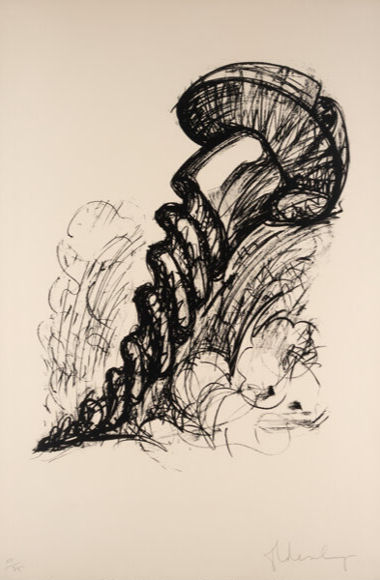
Soft Screw in Waterfall, from Soft Screw Lithographs, 1976
Lithograph on wove paper
67-3/8 x 45 inches
Ed. 15/35 (aside from 11 artist's proofs
Signed and editioned in pencil along lower edge; publisher's chop mark lower right
Published and printed by Gemini G.E.L., Los Angeles
LITERATURE:
Axsom & Platzker, 145;
Gemini G.E.L., 38.41.
Another impression of this work can be found in the collection of the Whitney Museum of American Art, New York.

Soft Drum Set, Lithograph 1972
Lithograph, 1972, on pale yellow Amgoumois à la main, signed with initials and dated in pencil, numbered 43/68 (there were also 6 artist's proofs), with the artist's and the Gemini G.E.L. blindstamps, Los Angeles, Axsom & Platzker,97

Cigarette Butt 1991
Lithograph in colors on Arches paper, signed in pencil and numbered 63/250, with the blindstamp of the publisher, Gemini G.E.L., Los Angeles, with full margins. Axsom & Platzker 230
10 x 10in (25.4 x 25.4cm)
sheet 19 x 18 1/4in (48.2 x 46.4cm)
Footnotes
In 1990, Harvey Gantt, a Democrat, challenged the conservative Republican Jessie Helms (1921-2008) for the Senate and lost. Oldenburg's image of a stubbed out cigarette is an oblique reference to Helms' long-standing support for the tobacco industry, and the '10/10' in the print refers to the late photographer Robert Mapplethorpe's controversial Ten by Ten portfolio, which enraged the senator.

Typewriter Eraser 1970
offset lithograph in colors, on Rives BFK paper, 1970, signed and dated in pencil, numbered 147/250 (there were also twenty artist's proofs), published by Paul Bianchini, New York, with the artist's blindstamp, the full sheet, 19 x 81/8in Axsom & Platzker 64

Compared to Brancusi's Kiss screenprint in colors on Arches image: 21½ h × 13¾ w in (55 × 35 cm) sight: 24 h × 16 w in (61 × 41 cm)
Drawings and Watercolor
Claes Oldenburg (American, 1929-2022), eight drawings for the Menu from II Corso del Coltello, 1985, each drawing titles: 'Aragosta Vellata alla Sleazy Dora,' 'Lettere di Pollo,' 'Crema di Tappeo e di Castagne,' Calzone con Pattini,' 'Biglie con Ricotta e Wurstel,' 'Spaghetti al Cartoccio Frankie Toronto,' 'Verza Ripiena alla Sandbag,' and 'Coccodrillo di Cioccolato.' Ball point pen, pen, and watercolor on paper, [approximate dimensions - sight (each): 4 3/4" H x 8 1/8" W, except Lettere di Pollo: 4 5/8" H x 6 5/8" W], initial signed and dated 'CO 85' at lower right; titled, written at low center. Margo Leavin Gallery, Los Angeles and Vivian Horan Fine Art, New York labels verso.


With his saggy hamburgers, colossal clothespins and giant three-way plugs, Claes Oldenburg has been the reigning king of Pop sculpture since the early 1960s, back when New York was still truly gritty. In 1961, he rented a storefront, called it The Store, and stocked it with stuffed, crudely-painted forms resembling diner food, cheap clothing, and other mass-manufactured items that stupefied an audience accustomed to the austere, non-representational forms in Abstract Expressionist sculpture. These so-called "soft-sculptures" are now hailed as the first sculptural expressions in Pop art. While his work has continued to grow in scale and ambition, his focus has remained steadfast: everyday items are presented on a magnified scale that reverses the traditional relationship between viewer and object. Oldenburg shrinks the spectator into a bite-sized morsel that might be devoured along with a giant piece of cake, or crushed by an enormous ice pack. His work shows us just how small we are, and serves as a vehicle for his smart, witty, critical, and often wickedly funny insights on American culture over the past half-century.

Claes Oldenburg
1929 - 2022
Seraphin Gallery, Philadelphia, PA
Comments