
James Joyce

James Joyce hopes to see lyric tenor John McCormack in 1924—a remarkable intersection of Irish culture
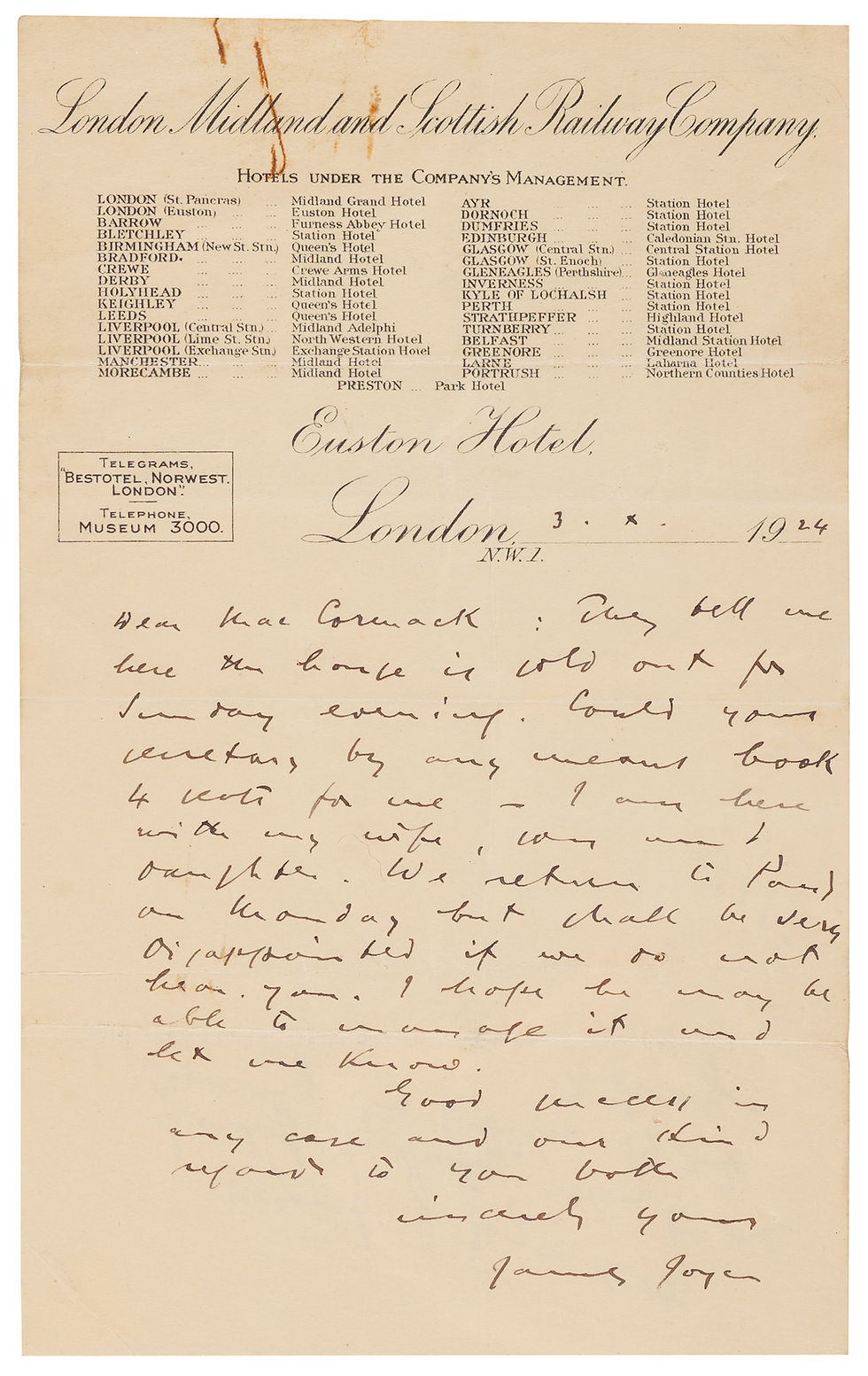
ALS, signed "James Joyce," one page, 5 x 8, Euston Hotel, London letterhead, October 3, 1924. Handwritten letter to "MacCormack," the celebrated Irish lyric tenor John McCormack, in part: "They tell me here the house is sold out for Sunday evening. Could your secretary by any means book 4 seats for me—I am here with my wife, son and daughter. We return to Paris on Monday but shall be very disappointed if we do not hear you." In fine condition, with a rusty paperclip impression to the top edge. Housed in a custom-made cloth presentation folder.The young James Joyce, possessed of a charming light tenor voice, gave serious consideration to a career in music. In 1904, encouraged by McCormack, he took some lessons, entered the tenor competition at the Feis Ceoil, an annual music festival in Dublin, winning the bronze medal. He would, it seems, have won gold, but for his refusal to attempt the compulsory sight-reading exercise. The high point of Joyce's musical career came on August 27, 1904, when he shared a platform with McCormack and J.C. Doyle at the Antient Concert Rooms; for one song, he accompanied himself at the piano.Joyce soon lost interest in making singing his career, but he always kept a close eye on his old friend McCormack's progress. According to Joyce biographer Richard Ellmann, Nora Barnacle used to remark in later years, 'Jim should have stuck to music instead of bothering with writing.' Some of his experiences on stage surely informed the short story 'A Mother,' from his 1914 collection Dubliners, which focuses on a domineering mother who pushes her daughter into a series of piano concerts to gain social status. He also refers to McCormack in his masterpiece, Ulysses, using the same misspelling of his last name seen here, when Bloom says: 'O yes, we’ll have all topnobbers. J. C. Doyle and John MacCormack I hope and. The best, in fact.'This letter captures a remarkable intersection of two towering Irish cultural figures, revealing Joyce not only as a literary giant but as a once-aspiring musician closely connected to McCormack. Their shared history—from performing together in Dublin to Joyce’s later literary reference to “MacCormack”—underscores an artistic kinship that bridges Ireland’s rich musical and literary traditions.
James Joyce hopes to see lyric tenor John McCormack in 1924—a remarkable intersection of Irish culture
ALS, signed "James Joyce," one page, 5 x 8, Euston Hotel, London letterhead, October 3, 1924. Handwritten letter to "MacCormack," the celebrated Irish lyric tenor John McCormack, in part: "They tell me here the house is sold out for Sunday evening. Could your secretary by any means book 4 seats for me—I am here with my wife, son and daughter. We return to Paris on Monday but shall be very disappointed if we do not hear you." In fine condition, with a rusty paperclip impression to the top edge. Housed in a custom-made cloth presentation folder. The young James Joyce, possessed of a charming light tenor voice, gave serious consideration to a career in music. In 1904, encouraged by McCormack, he took some lessons, entered the tenor competition at the Feis Ceoil, an annual music festival in Dublin, winning the bronze medal. He would, it seems, have won gold, but for his refusal to attempt the compulsory sight-reading exercise. The high point of Joyce's musical career came on August 27, 1904, when he shared a platform with McCormack and J.C. Doyle at the Antient Concert Rooms; for one song, he accompanied himself at the piano. Joyce soon lost interest in making singing his career, but he always kept a close eye on his old friend McCormack's progress. According to Joyce biographer Richard Ellmann, Nora Barnacle used to remark in later years, 'Jim should have stuck to music instead of bothering with writing.' Some of his experiences on stage surely informed the short story 'A Mother,' from his 1914 collection Dubliners, which focuses on a domineering mother who pushes her daughter into a series of piano concerts to gain social status. He also refers to McCormack in his masterpiece, Ulysses, using the same misspelling of his last name seen here, when Bloom says: 'O yes, we’ll have all topnobbers. J. C. Doyle and John MacCormack I hope and. The best, in fact.'This letter captures a remarkable intersection of two towering Irish cultural figures, revealing Joyce not only as a literary giant but as a once-aspiring musician closely connected to McCormack. Their shared history—from performing together in Dublin to Joyce’s later literary reference to “MacCormack”—underscores an artistic kinship that bridges Ireland’s rich musical and literary traditions.

James Joyce 1882- 1941
Seraphin Gallery, Jenkintown, PA
Rare Autographs and Documents
Comments